On this page
What daily BPC-157 amounts appear in the reported protocols?
Two documented accounts describe 250 mcg once a day and 250 mcg twice a day. The first supplies 250 mcg daily; the second supplies 500 mcg daily. Both describe six-week courses. These are individual accounts, not an established human dosing regimen.1, 2
| Schedule | Amount and frequency | Total per day | Total per week | Reference cycle |
|---|---|---|---|---|
| Once-daily protocol1 | 250 mcg once daily | 250 mcg / 0.25 mg | 1.75 mg | 6 weeks |
| Split daily protocol2 | 250 mcg twice daily | 500 mcg / 0.50 mg | 3.50 mg | 6 weeks |
Read any protocol in three parts: amount each time × administrations per day × days of use. “250 mcg twice daily” adds up to 500 mcg each day; it does not mean two 125 mcg portions. At seven days a week, those two schedules use 1.75 mg and 3.5 mg respectively.
Does splitting the daily amount change the total?
Splitting describes timing. A daily total of 500 mcg could be described as two 250 mcg amounts; changing the frequency alone does not create more peptide. Compare both frequency and total before comparing two accounts. The reports here do not test whether morning, evening or split timing works better.
A weekly calculation must also match the number of use days. For example, 250 mcg on five days totals 1.25 mg, while the same amount on seven days totals 1.75 mg. That example explains the arithmetic; it does not establish a five-day protocol.
BPC-157 products: vials, pens and premeasured formats
The vial contains 10 mg of powder. The pen contains 15 mg in 3 mL. These are the quantities used in the product comparisons below.
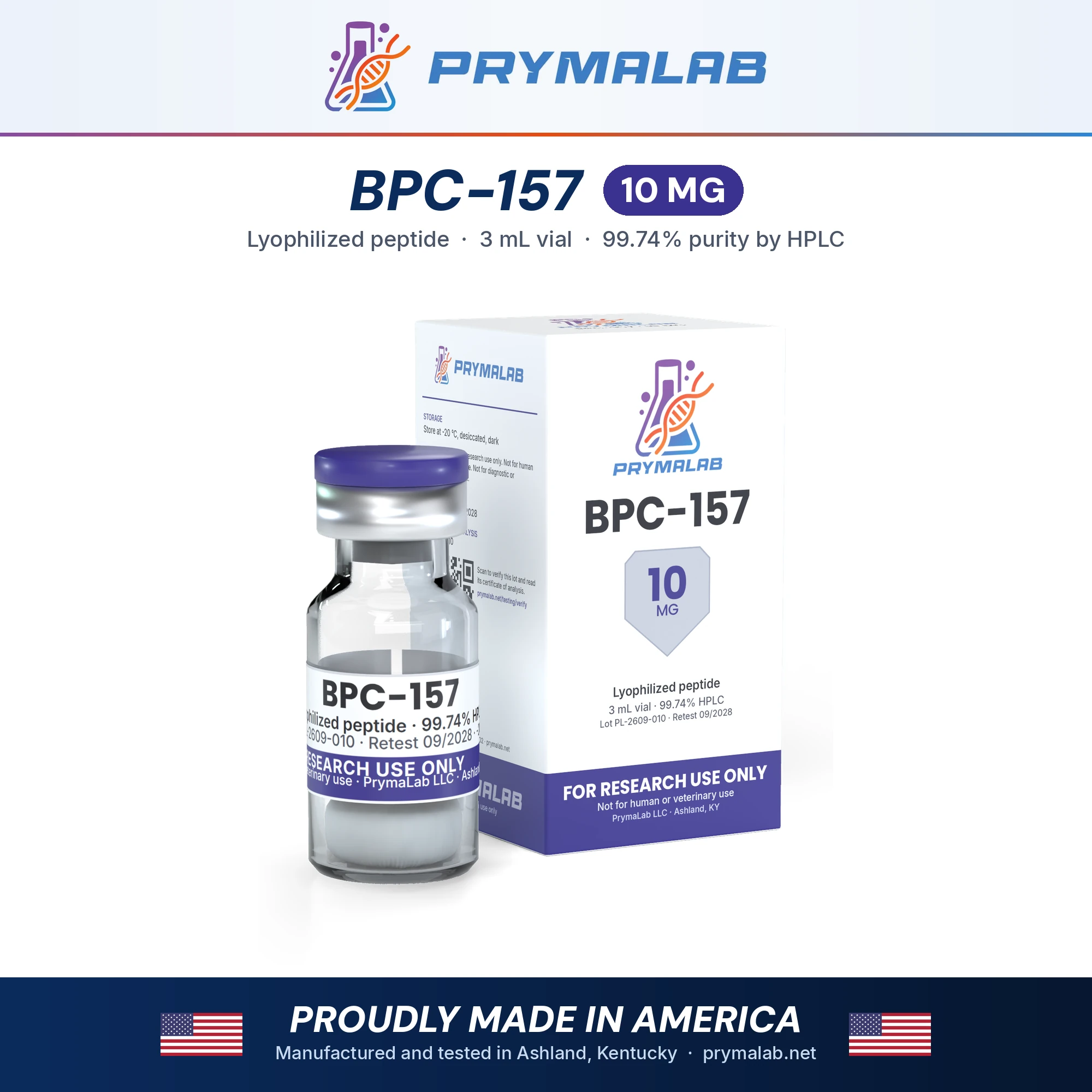
BPC-157 10 mg
10 mg of freeze-dried BPC-157 powder. Original COA for lot PL-2609-010 included.
- Total BPC-157
- 10 mg
- Physical form
- Powder
- Preparation
- Reconstitution required
- Documented lot
- PL-2609-010
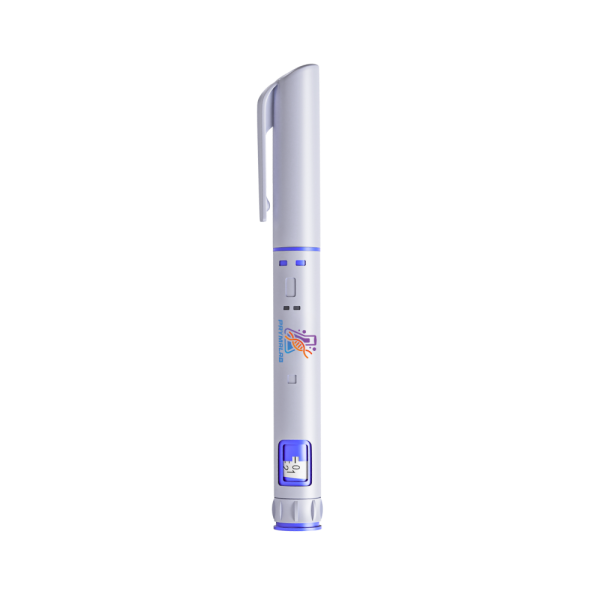
BPC-157 15 mg Pen
15 mg in a 3 mL prefilled pen. Concentration: 5 mg/mL.
- Total BPC-157
- 15 mg
- Liquid volume
- 3 mL
- Concentration
- 5 mg/mL
- Preparation
- Already in solution
Ordering is not yet available. Label quantities do not establish an effective human dose.
What supports a six-week cycle, and what about four or eight weeks?
Six weeks comes from the two cited personal reports. They describe changes around weeks two to three, with a plateau around week four in one account and further progress through week six in the other. The shoulder account included rehabilitation and moderate training, so the contribution of BPC-157 cannot be separated from those activities.1, 2
| Duration | Quantity difference | Reported timing and practical limit |
|---|---|---|
| 4 weeks / 28 days | Uses one-third less material than six weeks at the same daily amount. | Changes in comfort and movement were reported by this point; it is earlier than the end of the cited courses. |
| 6 weeks / 42 days | Matches the reference cycle. | Allows comparison with the full reported timeline, which included either further improvement or a plateau. |
| 8 weeks / 56 days | Uses one-third more material than six weeks. | Extending the schedule increases quantity and exposure; these reports do not show an additional recovery benefit. |
The four- and eight-week rows answer a supply question: how would a shorter or longer period change the quantity? They do not identify an optimal course. At a fixed daily amount, 28 days uses two-thirds of the material required for 42 days, while 56 days uses one-third more.
Identical totals can also hide different schedules. Four weeks at 500 mcg daily and eight weeks at 250 mcg daily both add up to 14 mg. That does not make their effects, risks or timing equivalent. The cited human evidence does not establish a maximum cycle length or a validated interval before restarting.3 Read the benefits and research guide alongside the reported timelines.
How many milligrams and 10 mg vials do the examples use?
Total milligrams = daily micrograms ÷ 1,000 × number of days. Divide that result by the vial's labeled 10 mg, then round upward to count whole packages. Six weeks at 500 mcg daily is 0.5 mg × 42 = 21 mg: two vials provide 20 mg, so the nominal package count is three.
| Daily amount | Duration | Total BPC-157 | Whole 10 mg vials | Nominal amount left |
|---|---|---|---|---|
| 250 mcg | 4 weeks | 7 mg | 1 | 3 mg |
| 250 mcg | 6 weeks | 10.5 mg | 2 | 9.5 mg |
| 250 mcg | 8 weeks | 14 mg | 2 | 6 mg |
| 500 mcg | 4 weeks | 14 mg | 2 | 6 mg |
| 500 mcg | 6 weeks | 21 mg | 3 | 9 mg |
| 500 mcg | 8 weeks | 28 mg | 3 | 2 mg |
The “amount left” column is the purchased label total minus the calculated course total. For the 21 mg example, three 10 mg vials provide 30 mg on the label, leaving a nominal 9 mg. It does not promise that this remainder can be recovered, stored or used later.
Portion count is not a storage period. Ten milligrams divides into forty 250 mcg amounts or twenty 500 mcg amounts. Neither result proves that a mixed vial remains usable for forty or twenty days. Transfer losses, retained liquid and the preparation's permitted storage period are separate constraints.
The quantity stays the same when the concentration changes. A vial labeled 10 mg still supplies a nominal 10 mg whether its final solution occupies 1, 2 or 3 mL. More diluent produces more liquid volume, not additional peptide.
What is the documented laboratory reconstitution process?
Reconstitution dissolves the powder in a compatible liquid so the concentration can be calculated. A labeled 10 mg in a final 2 mL gives 5 mg/mL. The following describes laboratory handling of a research product; it does not validate a human-injectable preparation.
- Match the vial to its records. Check the compound, 10 mg label, lot and container condition. Use the method applicable to that material. The original featured vial certificate identifies lot PL-2609-010.8
- Set up the preparation area. Work in a clean location and follow the laboratory's aseptic method. Use fresh sterile transfer equipment where required, protect contact surfaces and disinfect the rubber stopper with alcohol before access.5, 6
- Confirm which diluent the method specifies. The published vial material does not identify a diluent validated for human administration. Do not infer that the carrier used in a different premixed product is appropriate for this powder.
- Establish the intended final volume. The charts use 1, 2 and 3 mL as calculation examples. Check the method and container's usable working volume. A final-volume assumption is not a claim that every vial supports every example.
- Introduce the liquid slowly along the vial wall. The handling document says not to shake. Allow the preparation to dissolve under the specified method before measuring it. Unexplained particles or cloudiness are not a reason to improvise with heat or additional solvent.4
- Record the preparation and storage conditions. Label the compound, concentration, diluent, batch and preparation date. The original SDS specifies 2–8°C, light protection and a laboratory-established use period; it does not supply a universal number of days after mixing.4
Does a clear solution mean the preparation is sterile?
No. Appearance cannot establish sterility, and a photograph cannot determine why a preparation contains particles. Resolve an unexpected appearance against the applicable specification. CDC's medication-vial guidance says to discard a vial when sterility is compromised or uncertain.5
What do 250 mcg and 500 mcg equal at 1, 2 or 3 mL?
Keep mass, volume and syringe scale separate. One milligram is 1,000 micrograms. Milliliters measure liquid. On a U-100 syringe, 100 units on the scale correspond to 1 mL; the markings alone do not identify how much peptide that liquid contains.
| Final volume | Concentration | Volume containing 250 mcg | U-100 scale | Volume containing 500 mcg | U-100 scale |
|---|---|---|---|---|---|
| 1 mL | 10 mg/mL | 0.025 mL | 2.5 units | 0.050 mL | 5 units |
| 2 mL | 5 mg/mL | 0.050 mL | 5 units | 0.100 mL | 10 units |
| 3 mL | 3.333… mg/mL | 0.075 mL | 7.5 units | 0.150 mL | 15 units |
How can you verify one row without the calculator?
Start with total mg ÷ final mL. For 10 mg in 2 mL, the result is 5 mg/mL, or 5,000 mcg/mL. Next divide the amount to convert by that concentration: 250 ÷ 5,000 = 0.05 mL. Finally, 0.05 × 100 = 5 units on a U-100 scale.
The table uses final solution volume. It does not establish a compatible diluent or precision beyond the measuring device. A calculated 2.5-unit position may fall between a syringe's graduations. The same numbers must not be copied to a U-40 scale, another concentration or an autoinjector setting.
How do I calculate mL from milligrams and micrograms?
Enter the labeled total milligrams, the final liquid volume and the microgram amount to convert. The tool calculates concentration, the corresponding mL and U-100 volume markings. It cannot choose an appropriate dose or supply missing information about a diluent or device.
BPC-157 concentration calculator
Enter the container amount, final liquid volume and an amount to convert. The result shows concentration, mL and U-100 volume markings.
Formula: volume in mL = amount in mcg ÷ (mg per mL × 1,000). U-100 markings mean 100 units per mL; they do not apply to pen clicks or every syringe. Calculation precision does not establish measurement accuracy or suitability for human injection.
Recheck the inputs whenever the vial strength or final volume changes. The same 0.05 mL contains 500 mcg at 10 mg/mL and 250 mcg at 5 mg/mL. A saved screenshot of the previous result may therefore be wrong for a new preparation.
Which calculations change for a pen, capsule or nasal spray?
The featured pen contains a labeled 15 mg in 3 mL: 5 mg/mL. It arrives in solution and has no powder-reconstitution step. By mass alone, 15 mg equals sixty 250 mcg portions or thirty 500 mcg portions. Device priming and residual liquid can affect the number actually deliverable.
The reviewed information does not publish a calibrated volume per click. Knowing the cartridge total and concentration is insufficient to convert a desired amount into clicks. Use the product record to identify what is confirmed and what still needs device documentation.
| Format | Amount per capsule or spray | Package arithmetic | What is not established |
|---|---|---|---|
| Capsules | 500 mcg per capsule | 60 × 500 mcg = 30 mg per bottle | The amount absorbed compared with an injection. |
| Nasal spray | 150 mcg per spray | 30 mg total; 30,000 ÷ 150 = 200 nominal spray amounts | The usable spray count after priming or an equivalent injected amount. |
For straightforward label counting, two 500 mcg capsules contain 1,000 mcg and two 150 mcg sprays contain 300 mcg. The spray's labeled 30 mg divides into 200 nominal 150 mcg amounts, but that arithmetic is not a verified usable spray count. Its actual liquid volume remains unconfirmed.9
These calculations describe contents, not the amount reaching the circulation. Oral, nasal and injected micrograms cannot be treated as established absorption equivalents. Compare the capsule guide and nasal-spray guide for their own labels, handling and evidence.
Do injection-site reports establish where BPC-157 should be used?
Route descriptions are not interchangeable. Subcutaneous administration, mentioned in public reports, means the tissue beneath the skin. Intramuscular administration refers to muscle; intra-articular administration refers to a joint. The cited knee-pain publication used clinical joint injections, which should not be read as a self-injection method.1, 7
A person's statement that they used BPC-157 “near” an injury does not validate that location, technique or an advantage over another site. The human evidence cited here does not establish a benefit from local placement. Joint and tendon procedures require an appropriately trained clinician; pain in a structure does not make that structure a suitable self-injection target.
What else should I check before reading a dosage chart?
Can body weight determine a BPC-157 amount?
The accounts used on this page report fixed amounts, not a validated mg/kg formula. The cited human evidence does not supply an established consumer dosage chart by weight. A concentration calculator cannot fill that gap.3
What does 10 units mean in micrograms?
On a U-100 scale, 10 units on the scale equal 0.1 mL. That volume contains 500 mcg at 5 mg/mL, 1,000 mcg at 10 mg/mL, or about 333 mcg at 3.333 mg/mL. Establish concentration before converting the scale to micrograms.
Can I use the syringe chart to set pen clicks?
Only a documented volume per click or setting would permit that conversion. A 3 mL cartridge does not establish the click size, and no calibrated click specification was published in the featured pen information reviewed.
Does refrigeration make a mixed vial usable for 40 days?
No such duration is established by the cited handling sheet. Forty 250 mcg portions is a division of 10 mg, not a stability test. The SDS specifies 2–8°C with a laboratory-established use period, and the sealed product's retest date does not apply automatically after mixing.4
Is there an established break before another cycle?
The reports and human evidence cited here do not establish a restart interval. An account describing how someone felt after stopping is follow-up information, not proof that the same interval is suitable for restarting.3
Does 500 mcg of a Wolverine blend contain 500 mcg BPC-157?
A 1:1 blend splits its combined amount equally: 500 mcg total is 250 mcg BPC-157 plus 250 mcg TB-500. To contain 500 mcg of BPC-157, that ratio would also contain 500 mcg TB-500, making 1,000 mcg combined. This explains composition, not a product substitution. Use the BPC-157 + TB-500 guide for blend-specific calculations.
Where do the amounts, handling details and route distinctions come from?
The daily amounts and six-week courses are attributed to public personal accounts. The numerical tables are calculations from those amounts and product labels. Laboratory instructions, clinical-route distinctions and evidence limits have separate sources below.
- Six-week BPC-157 protocol and shoulder recovery report.Public community account: 250 mcg once daily, with continued rehabilitation.
- BPC-157 cycle duration and split daily use.Community discussion, February 2024. The BPC-only six-week course supplies the 250 mcg twice-daily example.
- FDA — BPC-157 briefing document.2026 Pharmacy Compounding Advisory Committee evaluation of the available clinical and safety information.
- BPC-157 vial safety data sheet, PL-SDS-019.Original laboratory handling document, revision 1.0; section 7 covers reconstitution and storage.
- CDC — preventing unsafe injection practices.Aseptic handling, clean preparation areas, single-use equipment and compromised sterility.
- CDC — standard precautions and safe injection practices.Includes alcohol disinfection of a vial’s rubber septum before access.
- Lee & Padgett — intra-articular BPC-157 for knee pain.Alternative Therapies in Health and Medicine, 2021. A clinical-route distinction, not a self-injection guide.
- Original 10 mg vial certificate.Lot PL-2609-010; in-house batch report.
- Original nasal-spray label.States 30 mg total and 150 mcg per spray.